Accessory Dwelling Units

"Accessory dwelling units" also known as a "second unit," means an attached or a detached residential dwelling unit that provides complete independent living facilities for one or more persons and is located on a lot with a proposed or existing primary residence. It shall include permanent provisions for living, sleeping, eating, cooking, and sanitation on the same parcel that the single-family or multifamily dwelling is or will be situated. An accessory dwelling unit also includes an efficiency unit and a manufactured home, as defined in Section 18007 of the Health and Safety Code. 

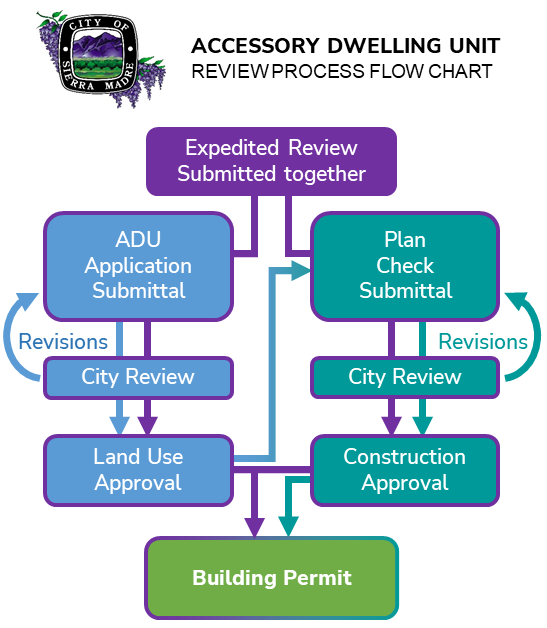
A ministerial review must be submitted for review to the Planning & Community Preservation Department prior to submitting for a Building Permit as part of the Plan Check Process to ensure compliance with the zoning regulations.

The Master Zoning Application is necessary to submit for any project in Sierra Madre requiring zoning clearance. The Accessory Dwelling Unit Submittal Checklist provides an itemized list of material to submit with the Master Zoning Application to begin review of the project.

One of the most commonly asked questions is "how much will it cost?"
We understand this is one of the most important key pieces of information needed for anyone to determine whether an ADU is feasible. Thankfully, there are multiple online resources that can not only help you determine costs, but help you understand how to recover your costs and how the long term investment improves the value of your property.

If you own an unpermitted accessory dwelling unit (ADU) or junior accessory dwelling unit (JADU) in Sierra Madre, we have great news for you!

In accordance with AB 2533, a streamlined process is now available to help you legalize your ADU or JADU that was constructed prior to January 1, 2020. This is an opportunity to ensure the dwelling unit is in compliance with the Health & Safety Code, while also enhancing its value.

To guide you through the steps please reference the following documents:

  •  
  •  
  •  
Housing and Community Development
The California Department of Housing and Community Development (HCD) is an excellent resource that provides guidance for building ADUs.

California Legislative Information

Government Code Section 66310 et. seq. outlines the state law with respect to the development of ADUs and JADUs

Review Process

Submitting an Application for Expedited Review

Expedited review allows the Accessory Dwelling Unit application, plan check application, and all accompanying materials to be reviewed concurrently at no additional cost. It does not guarantee immediate review or priority staff attention; it simply allows both processes to occur simultaneously.

This submittal option carries an inherent risk that staff comments on the ADU application may require design changes, which could result in additional soft costs, including re-engineering of structural details.

A letter from both the applicant and property owner acknowledging and demonstrating their understanding of this risk must be submitted with the Expedited Review application. A template letter is provided below.

Pre-Approved ADUs

The City of Sierra Madre is now accepting applications for pre-approved Accessory Dwelling Units (ADUs) and is utilizing the plans provided by designs firms below. Using the following designs is intended to expedite the plan check review time. For questions regarding the Pre-Approved ADU program, please contact the Planning & Community Preservation Department. 

Mei Li Homes, LLC.

DomADU, a 400 square foot, one bed, one bath layout with a pitched roof design. For additional information on the plans and designs, please contact Mei Li Homes, LLC

🌐 Website: thedomadu.com
📧 Email: meilihomes@gmail.com
📞 Phone: (909) 243-3022

neXt dwelling, LLC.

neXt 400 pre-approved ADU plan, a 400 square foot studio layout that is available in a variety of architectural styles and roof types to help you choose one that best fits your home. For additional information on the plans and designs, please contact neXt dwelling, LLC.

🌐 Website: nextdwelling.com
📧 Email: nextdwellingadu@gmail.com
📞 Phone: (424) 273-5861

Frequently Asked Questions

The City is now accepting applications for pre-approved Accessory Dwelling Units (ADUs) and is utilizing the designs from Mei Li Homes, LLC and neXt dwelling, LLC.  

For any updates or additional information, please visit the Review Process page for ADUs below or contact the Planning and Community Preservation Department.

Review Process for ADUs

As of 2022, the average cost to build an ADU varies between $270/square-foot to $600/square-foot, which typically translates to between $120,000 and $500,000 to build. Of this cost to build, city fees on average range between $8,000 and $18,000. One of the most commonly asked questions is "how much will it cost?"
We understand this is one of the most important key pieces of information needed for anyone to determine whether an ADU is feasible. Thankfully, there are multiple online resources that can not only help you determine costs but help you understand how to recover your costs and how the long-term investment improves the value of your property.

ADU: Accessory Dwelling Unit

An Accessory Dwelling Unit, or ADU, is a residential dwelling unit that provides complete and independent living facilities for one or more persons. An ADU may be located on the same lot as a single-family, two-family, or multi-family property. All ADUs include amenities for living, sleeping, eating, cooking, and sanitation. An ADU can be attached to an existing structure, detached independent from any structure, or converted from an existing structure.

An ADU must have exterior access and maintain clear unobstructed access from the adjacent street. Floor plan programming for an ADU will be similar to a studio apartment.

JADU: Junior Accessory Dwelling Unit

A Junior Accessory Dwelling Unit, or JADU, is a second dwelling unit contained entirely within a single-family residence which provides living facilities for one or more persons. A JADU may not be any larger than 500 square feet, may have shared facilities for sanitation with the single-family residence, and may provide an efficiency kitchen in lieu of a full kitchen.

A JADU needs to provide the same amenities as an ADU except that the JADU does not need to provide its own bathroom if access to a full bathroom in the attached primary residence is provided. Where an ADU can be seen as a studio apartment, a JADU is similar to a sublet room.


Development Standards

Size:

The City allows for an ADU up to 800 square feet in size, whether detached or attached, regardless of the zoning requirements for lot coverage, floor area and open space and regardless of the size of the existing residence.

The size allowed may be increased up to a maximum of 1,200 square feet if the requirements of zoning (lot coverage, floor area, open space, etc.) can be met.

Setbacks:

The minimum setback from a side or rear property line is 4 feet. The minimum setback from a front property line is the same as required for a primary structure for the zone of the property.

Height:

The height of an ADU is limited to 16 feet unless converted from an existing structure without modification or reconstruction.

Utilities 

The ADU needs to be connected to the existing water and sewer service. ADUs are not permitted a separate water meter unless determined otherwise infeasible by the Director of Utilities Services.

Only an address subordinate to the main address may be assigned to the ADU. For example, an ADU located on 330 W. Bonita Avenue may be assigned the address 330 1/2 W. Bonita Avenue; 332 W. Bonita Avenue would not be a permitted address assignment.

An ADU does not need fire sprinklers unless:

  1. Fire sprinklers are or were required for the main residence
  2. The Fire Marshal determines that access to the ADU is insufficient for emergency services

Installation of fire sprinklers is always encouraged when it is not required because Sierra Madre is located in a Very High Fire Hazard Severity Zone, drought conditions are worsening, and fire sprinklers provide a dramatic impact in saving lives in the event of a fire. 

Yes

Properties that have a year built date that is more than 75 years prior to the date an application for building permit is received will need a Historic Resource Evaluation.

You can check the year built date of your property by searching through the Los Angeles County Assessor Portal.

A Historic Resource Evaluation will determine if a property is eligible for designation as an historic landmark. If a property is found ineligible for designation as an historic landmark, then there is no further historic review. If a property is found eligible for designation as an historic landmark, then further historic design review of the proposed project is necessary to identify characteristics of the historic resource and measures to mitigate any impacts to the historic resource by the proposed project. A historic design review may result with some aspects of the proposed project to be changed.

Can an ADU be added to the property of a designated historic landmark?

Yes. For properties that are already designated historic landmarks, the Historic Resource Evaluation may be skipped, but a historic design review of the proposed project is required.

Please see Sierra Madre Municipal Code Section 17.22.140 (Ordinance No. 1454) for further details on the requirements for historic preservation.

Yes

Protected Trees include Oak, Sycamore, and Black Walnut trees. If any construction would take place under the canopy of any of these trees, then an Arborist Report, prepared by a qualified professional, is required. The Arborist Report will need to include:

  1. The location of the trunks and drip lines of all the protected trees on the project site or immediately adjacent to the project site which are affected by the project
  2. The species and diameter at breast height of each protected tree
  3. Whether or not the protected trees are to be removed or pruned as part of the project
  4. Photographs illustrating all of the protected trees on the site or immediately adjacent to the project site which are affected by the project
  5. Specific information on tree condition, analysis of the potential impact of the project on affected protected trees, valuation of the tree as calculated utilizing ISA tree valuation standards, recommended actions and mitigation measures, and proposed monitoring conditions with respect to one or more trees

The Public Works Department will review and consider the Arborist Report during the review of the Accessory Dwelling Unit application and may require the mitigation measures and monitoring procedures as recommended by the Arborist Report for approval of the Accessory Dwelling Unit application.

Please see Sierra Madre Municipal Code Section 17.22.150 (Ordinance No. 1454) for further details on the requirements for tree preservation.

1. Why should I add an ADU/JADU?

California is in a housing crisis and Sierra Madre is primarily a residential city which offers a beneficial opportunity to increase the housing stock which can have dramatic effects in addressing the housing crisis. ADUs can also provide passive income to homeowners as rental units that are far less expensive to build than full dwelling units.

2. Consider future development opportunity and limitations

Although adding and ADU to a property can be accomplished regardless of the zoning requirements for lot coverage, floor area, and open space, doing so may create limitations from further expanding the primary residence or other accessory uses/structures.

As an example, consider the following scenarios:

  1. A residential property currently has 2,500 square feet built and has a maximum allowable square footage of 3,000 square feet according to zoning code. If an ADU of 800 square feet is added, it will increase the built square footage to 3,300 square feet, which is 300 square feet beyond what is allowed by zoning code. In this condition, the property has a legal nonconforming status because the floor area built on the property exceeds the maximum allowable by zoning code. This condition limits the ability of the homeowner to expand the home's floor area.
    • To maximize development opportunity, the property can be expanded to the maximum allowable 3,000 square feet before adding an ADU. Once the property is at its maximum allowed floor area, an ADU of 800 square feet may be added resulting in a total built floor area of 3,800 square feet.
  2. When a garage is converted to ADU that results with no covered parking on the property, it becomes legal nonconforming because it does not meet the minimum required number of covered parking spaces. At some point in the future, should a homeowner desire to add a bedroom to the primary residence (not an ADU), the project will require compliance with the parking requirement which may not be possible with consideration of other zoning requirements such as maximum allowable floor area, setbacks, or access.
    • Homeowners should consider whether converting a garage or carport to an ADU would create this situation making it difficult to further expand their home and consider the option of adding a bedroom to the main house (if possible) before converting a garage or carport to an ADU. 

Lesson Learned:

Consider the ADU as a final-stage development after accomplishing all other desired development on the property since in almost all conditions of a property, an ADU of up to 800 square feet may be added or converted from a garage or carport.

It is highly recommended homeowners consult with a designer or licensed professional architect of their choice who has experience working in Sierra Madre. Think about where there might be opportunity to add an ADU to your property and consider whether converting existing space or constructing new space makes more sense. It is also recommended to discuss your options with a City Planner.

When you have decided that you want to add an ADU and have a general idea of how you would like to do it, review the submittal checklist for ADUs with a designer or licensed professional architect.

Once you have prepared all items in the submittal checklist, submit a Master Zoning Application to the Planning Department.

Sign up to our Newsletter

Stay up to date on the city's activities, events, programs and operations by subscribing to our eNewsletters.